


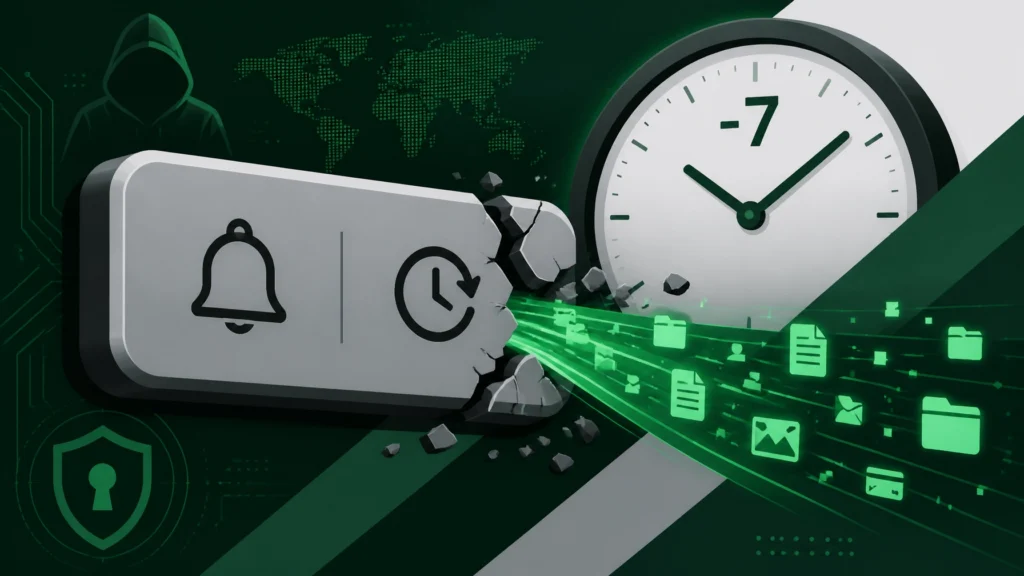
We’ve all been there. You’re in the middle of a focused work block, or perhaps you’re just about to hop into a critical Zoom call, and that little box slides into the corner of your screen: “Software Update Available.”
Without even thinking, your mouse cursor drifts toward the most comfortable button in modern computing: “Remind Me Later.”
For most business owners, this feels like a harmless delay: a digital equivalent of putting off the laundry for one more day. But according to the latest Vulnerability Statistics for 2026, that simple click has become the single most dangerous habit in your office.
At Thunder Rock, we’ve spent over a decade in the tech sector helping everyone from local small businesses to Fortune 100 giants. We’ve seen the landscape shift, but 2026 has brought a change that is fundamentally different. The window of safety you used to have: the few days or weeks between an update appearing and an attacker finding a way in: hasn't just shrunk.
It has disappeared. In fact, it has gone backwards.
The "Negative Seven Days" Bombshell
The most shocking statistic to emerge this year comes from Mandiant’s M-Trends 2026 report. They found that the mean time to exploit a given vulnerability is now negative seven days.
Let that sink in for a moment. On average, hackers are exploiting security holes a full week before the software company even releases a patch to fix it.
This means that by the time you see that "Update Available" notification, the bad guys have likely been knocking on your digital door for seven days already. When you hit “Remind Me Later,” you aren’t delaying a future risk; you are extending an active intrusion.
As CrowdStrike recently noted, 42% of exploited vulnerabilities are now attacked before there is any public disclosure at all. These are what we call "zero-days," and they are no longer the rare, high-tech weapons used only against governments. They are being used against businesses of every size, right now.
22 Seconds: The Speed of the Modern Breach
If the "negative seven days" stat didn't make you reconsider your patching schedule, perhaps this one will: Once a hacker gets initial access to a network, the handoff to a ransomware specialist now takes an average of 22 seconds.


In the time it takes you to read this paragraph, a breach can transition from a simple "foot in the door" to a full-blown ransomware deployment. The "breakout time": the time it takes for an attacker to move from one compromised computer to the rest of your network: has collapsed.
We work with you to ensure your systems can move quickly and scale on demand, but no human can react in 22 seconds. This is why automated, professional managed IT services aren't just a luxury anymore: they are the only way to keep pace with the machines on the other side of the screen.
Why the "Edge" is the New Front Line
For years, we told businesses to focus on their employees' laptops. While that’s still important, the 2026 data shows that attackers have shifted their gaze to your "edge devices": your VPNs, firewalls, and gateway proxies.
The Verizon 2025 Data Breach Investigations Report (DBIR) highlighted a staggering trend: exploitation of edge devices and VPNs jumped from 3% to 22% of all breaches in a single year. That is an 8x increase.
Why? Because these devices are the "front doors" to your business. They sit on the internet 24/7, and many businesses don't realize they need constant updates just as much as a Windows or Mac computer does.
Real-World Fallout: The 2025/2026 Hall of Shame
These aren't just abstract numbers. They represent real businesses that suffered real losses.
- CitrixBleed 2 (CVE-2025-5777): This single vulnerability saw over 11.5 million attack attempts within weeks of its discovery. Attackers used it to bypass Multi-Factor Authentication (MFA) entirely, walking right past the "locks" businesses thought they had in place.
- The Ivanti VPN Chain: Suspected espionage groups used a chain of vulnerabilities to deploy backdoors and credential harvesters, affecting over 28,000 exposed devices globally.
- CL0P Ransomware: This group has become infamous for mass-exploiting file-transfer tools. In early 2026, they were recorded hitting 21 different victims in a single 24-hour period.

The Firehose Problem: 48,185 Reasons You Can't Do This Alone
In 2025, there were 48,185 new vulnerabilities published. That’s a 20.6% jump from the previous year. To put that in perspective, that is over 130 new security holes discovered every single day.
The CISA "Known Exploited Vulnerabilities" (KEV) catalog: the list of bugs we know hackers are using right now: grew by 20% this year to 1,484 entries.
If you are a business owner trying to manage your own IT, you are trying to drink from a firehose. It is statistically impossible for a non-specialist to keep up with which updates are critical, which are "nice to have," and which might actually break your current setup.
How Thunder Rock Keeps You Safe, Secure, and Scalable
At Thunder Rock, our philosophy is simple: We handle the technology problems so you can focus on what you do best.
We don't just sell you software; we partner with you to build a tailored defense that fits your specific business needs. Here is how we address the "Negative 7 Days" problem for our clients:
- Proactive Patch Management: Our systems identify, test, and deploy critical patches across your entire network: including those pesky edge devices: safely and securely.
- Endpoint Detection and Response (EDR): Because 42% of bugs are exploited before a patch even exists, we use advanced EDR to monitor for behavior. If a computer starts acting like it’s being hacked, we see it and stop it instantly, patch or no patch.
- Managed Detection and Response (MDR): We provide the human expertise to back up the software. Our team analyzes threats in real-time, ensuring that "22-second" handoff never has a chance to happen.
- 24/7 SOC Services: Our Security Operations Center (SOC) never sleeps. Whether an attack comes at 2:00 PM on a Tuesday or 3:00 AM on Christmas morning, we are there to respond.
Let’s Stop Playing Catch-Up
The data is clear: the days of "manual" security are over. When the mean time to exploit is negative seven days, "Remind Me Later" is no longer an option: it’s an invitation.
But here’s the good news: You don’t have to stay up at night worrying about CVE counts or initial access brokers. That’s our job. We’ve spent over a decade mastering this sector so that you don't have to. We blend business acumen with technical prowess to ensure your tech solutions are a perfect fit for your goals, not a drain on your pocketbook.
Is your business ready for the reality of 2026?
Don't wait for the next "Update Available" popup to find out. We’d love to help you build a strategy that keeps you ahead of the curve.
Get in touch with us for a free advisory call! Let’s talk about how we can work together to keep your business moving forward, safely and securely.